Many children from immigrant families encounter educational, linguistic, cultural and social barriers while settling in the U.S.A. About one in five school-aged children in America speaks a language other than English at home, and of those children, approximately one-third speak English with difficulty (Sadker, Sadker, & Zittleman, 2008). As these non-English speaking students enter schools, most will need to make sense of a new language, a new culture, and possibly new ways of interacting with teachers and classmates. To expand awareness of their difficulties and help them adapt to their new environment, we should educate our students as early as possible to appreciate individual and cultural differences, show tolerance, respect and acceptance toward newcomers. | 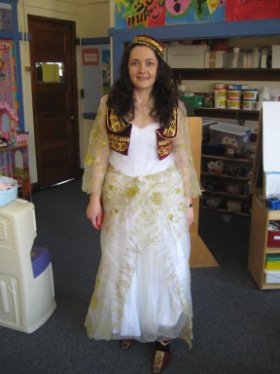 |
This is the aspiration of this picture book unit conceived for first graders. We will present three books, which describe stories of immigrant children trying to adapt to their new life in America, and we will finish with children describing the diversity of our own classroom. We want students to comprehend that only by accepting differences, being empathetic and welcoming to newcomers will we create a safe and nurturing environment for our community to grow stronger.
The first book we will present is “Angel child, dragon child” which is a touching, real life story about a Vietnamese girl, Ut who is trying to adjust to her new life in America. Her mother was left behind in Vietnam for economic reasons. Children laugh at her when she speaks in Vietnamese and wears her traditional dress to school. The same children, once they realize her difficulties will help her mother to join the rest of the family. We would like children to recognize that even though people may look or dress differently, they share the same feelings, need for love and recognition as everyone else.
The second book we will present, “My name is Yoon”, is a moving story that depicts a Korean girl’s difficulty in maintaining her identity while adjusting to her new life in America. Yoon, or "Shining Wisdom," thinks that her name looks much happier written in Korean than in English. Yoon isn’t sure that she wants to be Yoon, so she tries different names: cat so she can hide and be cuddled by her mother; bird so she can fly back to Korea and cupcake so children will love and accept her. In the end, encouraged by her classmates and her teacher, she comes to accept both her English name and her new American self, recognizing that however it is written, she is still Yoon. By reading this story we want students to learn to appreciate differences and be proud of their origins.
The third book presented will be “I hate English” which describes the difficulties that Mei Mei, a bright and articulate immigrant from Hong Kong, is having adjusting to the new language and culture at school. A sensitive teacher will help her overcome the fear of losing her identity and express herself in English. This story will familiarize students once again with the difficulties that immigrant children encounter with the language and American culture and reinforce their appreciation of differences.
The presentation of the three books will be succeeded by a final activity: “Multicultural week”, where the children will be asked to interview their parents and grandparents and identify the origins of their family. They will share their findings in class. It is hoped that this activity will help children appreciate the richness of American culture, be proud of their origins and bring them together to build a stronger community.
First lesson plan: Book presentation: Surat, M., M. & Mai V., D. (1989). Angel child, dragon child. New York. Scholastic Inc
Grade level: 1st grade
Primary content: Social studies: the principal strand is the multicultural approach integrated with geography and economics. The themes that we will develop are language (Vietnamese), citizenship, family and friendship.
Purpose of lesson and lesson overview:
- Expand awareness of difficulties that immigrant children encounter in an American school.
- Teach inclusion of immigrant children in the community by promoting tolerance, respect and acceptance.
Time: The book is presented and discussed in 2 sessions of 20 minutes: first session pages 1-13 and the second session pages 14-31.
Focusing questions addressed in the lesson:
1. What do you think you can do to help immigrant children to adapt to their new American school?
2. How can immigrant children be different and similar to American children? (Student will be directed to draw differences: the way they dress, the language they use etc, and similarities like: they both go to school to learn, they both have the same basic needs and share the same feelings, same non verbal language to express emotion etc.)
Discussion questions:
1. Why did the author choose the title “Angel child, dragon child”? What do you think are the characteristics of an angel child, and a dragon child?
2. What are the difficulties that Ut encounters in her new American school?
3. What do you think about the children’s reaction when they saw Ut and her sisters the first day at school?
4. Can you describe Ut’s feelings in the beginning of the school year?
5. What do you think about Raymond’s behavior in the beginning, and after he knew Ut’s mother’s story?
6. Why was the Vietnamese fair that the children and teachers organized successful? (The children came together to organize a Vietnamese fair and raise money for Ut’s mother to come to the US. The economic aspect will be also discussed).
Students will know or be able to:
· Identify difficulties of immigrant children in America.
· Compare immigrant children to American children by drawing similarities and differences.
· Recognize the immigrant children’s need for support and inclusion in the community.
· Demonstrate tolerance and acceptance toward newcomers while in a role-play situation.
Materials:
· Book "Angel Child, Dragon Child" with notes for pages 4, 7, 9, 26, 28-31 to explain Vietnamese words and discuss longer the Vietnamese traditional dressing, food, and culture.
· Chart paper set up, markers.
· Globe, map.
· Computer ( to search for information about Vietnam).
Instructional practice:
· Children will be seated in a circle to listen to the story. I will show them the cover of the book and ask what do they notice. After reading the title of the book, I will solicit them to tell me what they think the story will be about.
· Before beginning to read the story, a few words would be said about the life of the author, who is a high school teacher in Vermont and explain how she came up with the idea of writing this book. Actually, she was inspired by a true story that happened to her and which she wished to share. This is her first book and was dedicated to the real Ut and her sisters. A few words would be said also about the illustrator who is a well-known Vietnamese writer, translator and illustrator and lives in Maryland.
· Children would be asked if they have heard of Vietnam before. If they know someone and if they have any idea where in the world it may be. After that they will try to locate Vietnam on the globe and on a map. If needed, direction will be given to try to locate first Asia as a continent and after look for Vietnam.
· I will than begin to read aloud the story and will stop on page 4 to ask students if they notice something in particular in the illustration. I would like them to point out the way that the Vietnamese girls are dressed, the colors of the trees to find out the season. If they do not remark these details I will guide their observation by questioning.
· During the reading we will take more time to explain the greeting in Vietnamese “Chao buoi sang” (which we would write on the chart paper) and the signification of bowing (page 9) which shows respect for others and will compare it to the American custom of handshaking.
· On page 26 we will explain what an ‘ao dai’ is, a traditional cloth: large pants and a dress and show the illustration to notice the different colors that an “ao dai” can be. It is important for children to understand that people in different countries have different traditional clothes, as we may consider popular to wear jeans and shirts. This will help children to see the dress code from a different point of view.
· On page 27 we will talk about typical Vietnamese food: rice cakes, imperial rolls, sesame cookies. Similarities with the Asiatic cuisine will be drawn. Students’ food experiences can be explored. They will be asked if they have asian cuisine like Chinese food? We can extend by showing pictures (on the computer or print in colors) of traditional dishes in Vietnam described and illustrated at www.asiatravelmag.com
· On pages 28 -31 talking about the seasons, we will explain the significance of the ‘hoa-phuong’ flower or flamboyant tree. The flowering season in Vietnam is April - May, which coincides with the end of the school year. Because of this timing, the “hoa-phuong’ is sometimes called the "flower of pupil" as it bloom when they are about to leave their school and one year of their childhood behind.
· We will finish the story with the ending of the school and the arrival of Ut’s mother.
· A quick review of what we have learned from the story will be done to solidify the new knowledge.
Motivation: During the reading the pictures will be pointed to captivate children’s attention. To keep them focused during the reading they will be asked to make predictions. The intonation of voice will be changed when the characters are speaking.
Assessment: The assessment will be through interviews and situation of role-playing. Children will be interviewed and asked questions like: How can you describe the difficulties that Ut encounters in her new American school; In what way is Ut similar and different to her American classmates?; Imagine that Ut was in your school, what would you have done to help?
In the role-play situation: the whole group is seated and I will ask for two volunteers. One child will play a newcomer and the other a current student. I will observe how the situation is handled and if the behavior of tolerance and acceptance is not observed I will ask the children that are observing if they have another idea on how to handle the situation. When the right attitude is observed it will be reinforced.
Next step: In the next lesson we will read another similar story about the difficulties that a Chinese girl has writing her name and expressing herself in English. The book is tilted “My name is Yoon”.
Adaptation: For children with attention deficit, prediction of the story will be asked to keep them involved during class reading. If necessary, individual work will be done with the child to ensure the comprehension of the story.
Pitfalls and solutions: We can run out of time. In this case, the assessment and the role-play situation can be done in a third session.
Second lesson plan: Book presentation: Recorvits, H. & Swiatkowska G. (2003). My name is Yoon. New York. Frances Foster Books
Grade level: 1st grade
Primary content: Social studies: the principal strand is the multicultural approach integrated with geography. The themes that we will develop are language (Korean), citizenship, family and friendship.
Purpose of lesson and lesson overview:
- Expand awareness of difficulties that non-American children encounter in their new American school.
- Educate appreciation for people’s different origins and cultures.
- Reinforce awareness about each other’s individual identity.
Time: The book is presented and discussed in two sessions of 20 minutes. During the first session we will read and discuss the story. In the second session we will finish the discussion and do the assessment.
Focusing questions addressed in the lesson:
1. How could you describe the difficulties that Yoon encounters in her new American school?
2. In what way do you think Yoon is similar and different to American children?
3. What do you think you can do to help children like Yoon to overcome difficulties?
Discussion questions:
1. Why do you think Yoon didn’t like America at the beginning?
2. Why do you think Yoon didn’t want to write her name in English?
3. Why did Yoon want to be a cat? (The discussion will be oriented if children do not point out that she was shy, she wanted to hide etc).
4. Why did Yoon want to be a bird? (So she can fly and go back to her “nest” to Korea)?
5. Why did Yoon want to be a cupcake? (So children could love her).
6. Who helped Yoon surpass the difficulties of writing her name and how?
Students will know or be able to:
· Identify difficulties of immigrant children in America.
· Appreciate differences of people’s origins and cultures.
· Recognize and appreciate the fact that everyone is unique.
· Recognize the immigrant children’s need for support and inclusion in the community.
Materials:
· Reading The book "My name is Youn" with notes for pages 4 to write the name of Yoon in Korean, page 18 to discuss the relationship of Yoon and her mother, page 24 to notice the difference in Yoon attitude.
· Chart paper set up, markers.
· Globe, map.
· Computer (searching for information about Korea)
Instructional practice:
· Children will be seated in circle to listen to the story. I will ask them if they remember from the last session the title of the book that we are reading today. I then would show the cover of the book, present the author, who lives in Rhode Island and the illustrator Gabi Swiatkowska who is originally from Poland and lives in New York.
· I will say that the story this time is about Yoon, a Korean girl, and ask if they have already heard about Korea. Students will be asked to try to locate Korea on the globe and on the map. Directions will be given if necessary.
· I will begin to read aloud the story pointing at the pictures and at page 4, I will write down in the chart board the name of Yoon in English and also in Korean as it is written in the book. The aim is that children notice that the same name can be written differently in English and Korean. I will ask them to comment on why Yoon says that in Korean the symbols seem to dance together (the forms of letters, direction of writing from up down). I will stress that even though the name Yoon in English does note have any special meaning, in Korean means “Shining wisdom” and this meaning is really important to Yoon.
· At page 18 I will ask children what they think about the discussion of Yoon with her mother and how can they describe Yoon’s feelings when she says, “at my school in Korea I had many friends. Here I am all alone” and how do they understand the mother when she says, “You must be patient with everyone, including yourself”.
What does it means being patient with oneself? (Children will be directed to discuss about giving oneself time to get know each other, to get used to a new environment etc).
· At page 24 I will ask children to describe what’s different in Yoon’s attitude and thoughts when she sings in English and when she says, “Maybe America will be a good home. Maybe different is good too”.
· I will finish the story by saying that Yoon can write her name in English now and it still means “Shining Wisdom”.
· At the end, I will shortly summarize the story to reinforce knew knowledge.
Motivation: The pictures of this book are full page and have bright colors, which can draw children’s attention. Also, children will be asked to make prediction to stay focused on the story. Gestures can be done to illustrate a hiding cat (I can cover my face with the book), a bird flying (using my arms). The intonation of voice will be changed when the characters are speaking.
Assessment: Students will be assessed through interviews. They can answer questions like:
1. How can you describe the difficulties that Yoon encounters in her new American school?
2. In what way is Yoon similar and different to her classmates?
3. Imagine that Yoon was in your school, what would you have done to help?
To assess that children appreciate the fact that everybody is unique, at the end of the first session students will be asked to search the origin of their names and in the second session of this lesson they will answer to the questions like:
1. Where did your name come from?
2. Who named you and why?
3. What do your name(s) mean or symbolize? to you? to others?
4. Do you have any nicknames?
Every student will have a turn to talk about his/her name. The way they discuss will be observed.
Next step: In the next lesson we will read another similar story about the difficulties that a Chinese girl, Mei Mei, has talking and expressing herself in English. The book is tilted “I hate English”.
Adaptation: Student that may have a hearing difficulty, will be asked to sit near me. During the reading I will point at words and relate them to pictures to keep him/her focus. If necessary, individual work will be done with the child to ensure the comprehension of the story.
Pitfalls and solutions: During assessment some students may not show appreciation for their names and the fact that they are unique. We may also have twins in our classroom and can be difficult for them to realize their individuality. In this case, additional work will be done during the year to express appreciation for the way they are, reinforce the fact that they can have different ideas, like different kind of games, foods etc.
Third lesson plan: Multicultural week
Grade level: 1st grade
Primary content: Social studies: the principal strand is the multicultural approach integrated with geography. The themes that we will develop are language, citizenship, family and food.
Purpose of activity: After these activities it is hoped that students will:
- Become aware of his/her culture heritage
- Become sensitive to ethnic differences.
- Become confident and proud of his/her culture/traditions.
Activity and timing:
- Organize a “Show and Tell” where students will be asked to research their family heritage to see if their ancestors have come from other cultures and countries or states. They will bring information (pictures, objects, CDs with traditional music) about the country their parents or grandparents came from and share cultural traditions that they experienced. (Session of 40 minutes, 10 minutes per child, each day after meeting time for a class of 20 students).
- In two sessions of 20 minutes two different parents will be asked to volunteer and present their country or state of origin.
- At the end of the week parents will volunteer to share with us a typical recipe from their country of origin.
Material:
· A questionnaire (see annexes) inspired by Sparks, 1989 will be given to students one week before the beginning of the Multicultural Week.
· Globe, map
· Chart paper set up, markers
· Computer (to listen to CDs and search for information if necessary)
Students will know or be able to:
- Present their country or state of origin based on the information asked in the questionnaire.
- Locate the place of their origin in the globe and in the map (with help if necessary).
- Have a greater appreciation for individual differences and understand what takes place in different cultures.
Instructional practice:
Before starting multicultural week, we will contact the parents to ensure their collaboration during this week: answering the questionnaire that will be given, helping children find materials about their country of origin. Two parents will volunteer to give a more detailed presentation of their country. I will check with them to ensure that the material is appropriate for children at a young age. A list of what day, at which time and what country or state the children are presenting will be made.
- The first day of the multicultural week I will greet students in an Albanian traditional costume (hoping for the surprise effect). After the meeting, I will locate Albania in the globe and in a map and give them some information about the language, say the alphabet in Albanian and count to 10. I will answer their question and respecting the schedule established, I would invite students to present their places of origin based on the questionnaire that they completed with their parents or grandparents. Students may also share pictures, objects, CDs with traditional music.
- Two parents (in different days) will be invited to volunteer and present more detailed information about their countries of origin. Their children will begin the presentation and the parents will complete and answer questions.
- Friday, the last day of multicultural week, parents will bring a typical dish, prepared with the help of their child. Students will share their experiences and talk about ingredients in their recipe. We will all taste the food and thank each one of them for their participation.Motivation. The presentations will be brief to correspond to the short attention spam of young students. They will be encouraged if they are timid to present their country or state of origin. They will also be encouraged to ask questions to their classmates after presentation.Assessment: At the end of the week, in groups, children will be asked to describe what they remember about each other’s country or state of origin. They will be asked if they learned something new this week and their favorite activity. Questions also will be asked about whether they found any difficulties in completing their questionnaire with their parents, in order to improve the process of gathering information.Next step: During the weeks to come after this activity we will continue the work done during multicultural week by presenting students with different types of alphabets (Egyptian, Arabic, Chinese etc).Adaptation. If in our classroom we have student with limited English proficiency, we can help him/her to present the country of origin through pictures, songs using simple structures phrases and known vocabulary (Seefeldt, Castle, & Falconer, 2005).Pitfalls and solutions: This activity can be emotional for certain children who don't know about their heritage and those who have been adopted. If someone seems to be getting emotional they will be remind that they only have to reveal what they feel comfortable revealing. Also, before preparing their recipes I will remind parents to avoid ingredients that students in class can be allergic to.
Conclusion
In today’s schools along with the curriculum we emphasize education of democratic values like tolerance, kindness and acceptance in the aim to build a strong community. We want our students to be confident, proud of their cultural identity by creating a cooperative, interactive learning environment free of discrimination. In this context, this picture book unit is only the introduction of continued work that has to be done to create a positive, inclusive and multicultural environment.
Bibliography:
Levine, E., & Bjorkman, S. (1989). I hate English. New York. Scholastic.
Recorvits, H., & Swiatkowska, G. (2003). My name is Yoon. New York. Frances Foster Books.
Sadker D., M., Sadker, M., P., & Zittleman, K., R. (2008). Teachers, schools and society. New York. McGraw-Hill.
Seefeldt, C., Castle, S., & Falconer, R., C. (2005). Social studies for the preschool/primary child. New Jersey. Pearson.
Sparks, L., D. (1989). Anti-bias curriculum. Tools for empowering young children. Washington DC. NAEYC.
Surat, M., M., & Mai, V., D. (1983). Angel child, dragon child. New York. Scholastic.
Annexes
Family history questionnaire*
This questionnaire is part of our Family history/Multicultural Project. Please work with your child to fill the answers and return to school by………… Thank you for your collaboration.
1) I was born in …………………………………………………..(city/state)
2) My mother’s name is …………………She was born in………………………(state or country).
3) My father’s name is …………………He was born in………………………(state or country).
4) My mother’s parents live or lived in ………………………(state or country).
5) They were born in……………(state or country)…and………………………(state or country).
6) My father’s parents live or lived in ………………………(state or country).
7) They were born in……………(state or country)…and………………………(state or country).
8) Did my grandparents or great-grandparents come from another country?
Which person?
Which country?
8) What is my family’s cultural/ethnic heritage
9) Does our family have special customs or traditions? What are they?
10) Is there something special that you want to share with us for this event (you can share stories, pictures, Cds with traditional music etc)
*Answers reflect the child’s history.
